Pricing guide
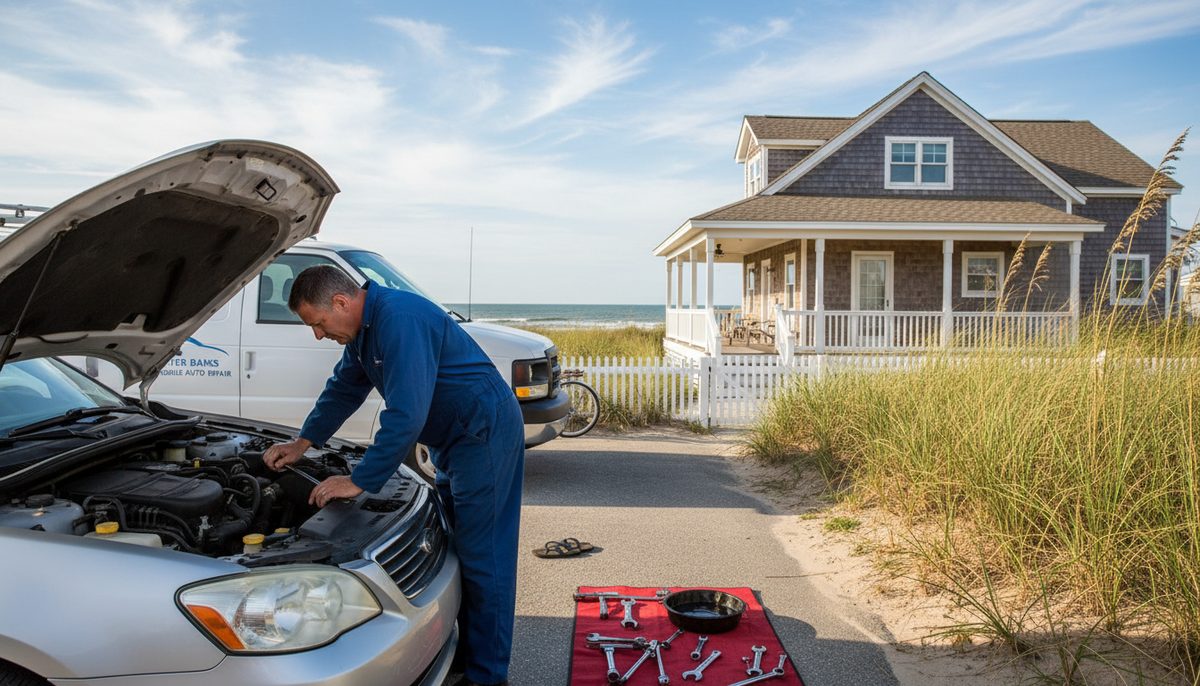
What a vehicle inspection costs on the Outer Banks
What a North Carolina vehicle inspection actually costs on the Outer Banks: the statutory $12.75 safety fee, the $23.75 combined fee you do not owe here, and what a failed inspection adds.
The only price in this trade the General Assembly wrote down
Nearly every dollar figure you will ever be quoted for work on a car is a business decision. A shop sets its labor rate, a parts supplier sets a price, and the two get added together. None of that is legislated, and any page that claims otherwise is guessing at your expense. There is exactly one exception in North Carolina, and it is the reason this page exists: the annual inspection is priced in the General Statutes, in cents, and the number is the same at every licensed station in the state.
That makes the inspection unusually easy to budget and unusually easy to check. If a station on this beach quotes you something other than the statutory figure for the test itself, you are not looking at a market rate. You are looking at an error or at something worse, and you can say so with a statute number in your hand.
$13.60 here, $30.00 in Charlotte — the actual range
Start with what the statute charges for the test. The safety inspection fee $12.75 is the figure in G.S. 20-183.7 for a safety-only inspection, and on top of it sits an $0.85 electronic inspection authorization fee that covers filing the result with the Division. Added together, the whole legally-set cost of getting a car inspected on the Outer Banks is $13.60.
The other end of the range is what drivers in nineteen North Carolina counties pay. There, the emissions + safety fee $23.75 applies for a combined emissions-and-safety inspection, and the electronic authorization fee on that transaction is $6.25 rather than $0.85 — a total of $30.00. So the statewide spread for the identical legal obligation runs from $13.60 to $30.00, and where you fall in it is decided entirely by the county on your registration, not by the car, the mileage, or the station you choose.
Two things follow. First, a price comparison between stations is not worth the phone call; the fee is fixed. Second, if you have just moved a vehicle's registration here from Wake or Mecklenburg, your annual cost for this line item has dropped by more than half and you should stop budgeting the old number.
Why the cheaper end is the one Dare County owes
The reason is a list, and the list is the whole argument. Emissions testing in North Carolina is not statewide — it applies to vehicles registered in specific named counties, and Dare, Currituck and Hyde are not among them. That is what safety-only inspections on the OBX means in practice: a vehicle registered at a Corolla, Kill Devil Hills, Manteo, Hatteras or Ocracoke address is tested for safety and nothing else, so the emissions half of the combined fee never attaches.
This is a verified absence rather than a local courtesy, and the distinction matters when somebody tells you otherwise. The county list lives in the statute and is reprinted by the Division of Motor Vehicles; the coast northeast of Wilmington does not appear on either version of it. Nothing about being asked for an emissions test at an Outer Banks station is normal, and the correct response is to ask which county the station thinks your plate is registered in.
One caveat worth budgeting for: the exemption follows the registration, not the driver. A vehicle still titled at a Raleigh address and garaged in Nags Head owes the Wake County test, at the Wake County price, no matter where it sleeps.
The fee is charged whether you pass or fail
This surprises people every year and it is not negotiable. The statutory fee attaches to the performance of the inspection, not to the outcome. A car that fails on a worn tire has still consumed the station's time and the Division's electronic filing, so the money is owed, and a re-test after repairs is a second inspection.
The practical consequence is that you want the obvious failure points sorted before the car goes on the rack rather than after. Lights, wipers, horn, mirrors, tires and brakes are not mysteries; they are visible in a driveway with a flashlight and ten minutes. On this island the two that fail most often are tires, because sand and heat are unkind to sidewalls, and bulbs, because salt air gets into every socket on a vehicle that parks within sight of the water.
What a failure actually costs, after the $13.60
Here the statute stops setting prices and starts setting procedure, which is still worth money to you. Once the inspection has identified work, the repair falls under the Motor Vehicle Repair Act — and the moment the total will run past three hundred and fifty dollars, the written estimate required over $350 rule applies. Parts, labor, diagnostics, taxes and incidentals all count toward that threshold, and the estimate has to be in your hands before any work or diagnosis starts unless you sign the right away.
That estimate is the number to negotiate, not the inspection fee. It is also the number the rest of the job is measured against: the shop cannot bill past it by more than ten percent without your authorization, and it has to tell you before it gets there rather than after.
There is a second deadline with a price on it. Letting the inspection slide is not free — the annual obligation below has a penalty attached, and it is not small relative to the fee.
The annual clock, and the money attached to missing it
The obligation itself is simple: an annual safety inspection before registration renewal is required for every vehicle registered in this state, Dare County included, and the test can be done up to ninety days before the plate expires. Those ninety days are the useful part of the rule. They let you put the car in front of a station in a week when the beach is empty rather than in a week when every bay on the Bypass is full.
Miss it and the cost changes character. Four months past due, a fifty-dollar civil penalty attaches and registration renewal is blocked until it is paid, so the real expense stops being the fee and becomes an unregistered vehicle on an island with one road out. That is a far more expensive problem than thirteen dollars and sixty cents, and it is the entire argument for using the ninety-day window instead of the last week.
What this page will not print, and why
You will not find a brake job range, an alternator price, a diagnostic hour or a mobile call-out fee anywhere above. Not because we do not have them — we quote them every day — but because no named, dated authority publishes Outer Banks auto repair pricing, and a range invented for a web page is a guess wearing a decimal point. The facts file behind this site lists those items explicitly as unverifiable, and leaving them out is the whole reason the numbers we do print can be trusted.
What you can rely on: every figure above comes from a statute or a Division of Motor Vehicles page that was read on the date shown at the foot of this page, and every one of them can be checked against the source in about a minute. What you should ask us for: a real quote for your actual car, which is a phone call rather than a table.
Registration county, plate expiry month, and what the car is doing that worries you — those three things get you a firm number for the work and the right statutory fee for the test, with no surprises in between.
On the record: safety inspection fee $12.75 (N.C.G.S. 20-183.7 — Fees for performing an inspection (ncleg.gov, retrieved 2026-09-17)) · emissions + safety fee $23.75 (N.C.G.S. 20-183.7 — Fees for performing an inspection (ncleg.gov, retrieved 2026-09-17)) · safety-only inspections on the OBX (NCDMV — Vehicle Emission Inspection 19-county table (ncdot.gov, retrieved 2026-09-17)) · annual safety inspection before registration renewal (NCDMV — Vehicle Safety Inspection (ncdot.gov, retrieved 2026-09-17))
Hand-verified 2026-09-17 against the primary sources named above; where a fact could not be verified it was left out, never guessed.